Online Manual Handling Course
Course last updated: June 2026
Course certificate valid for 3 years
UK & EU accredited training
Course duration: 1 hr 30 mins
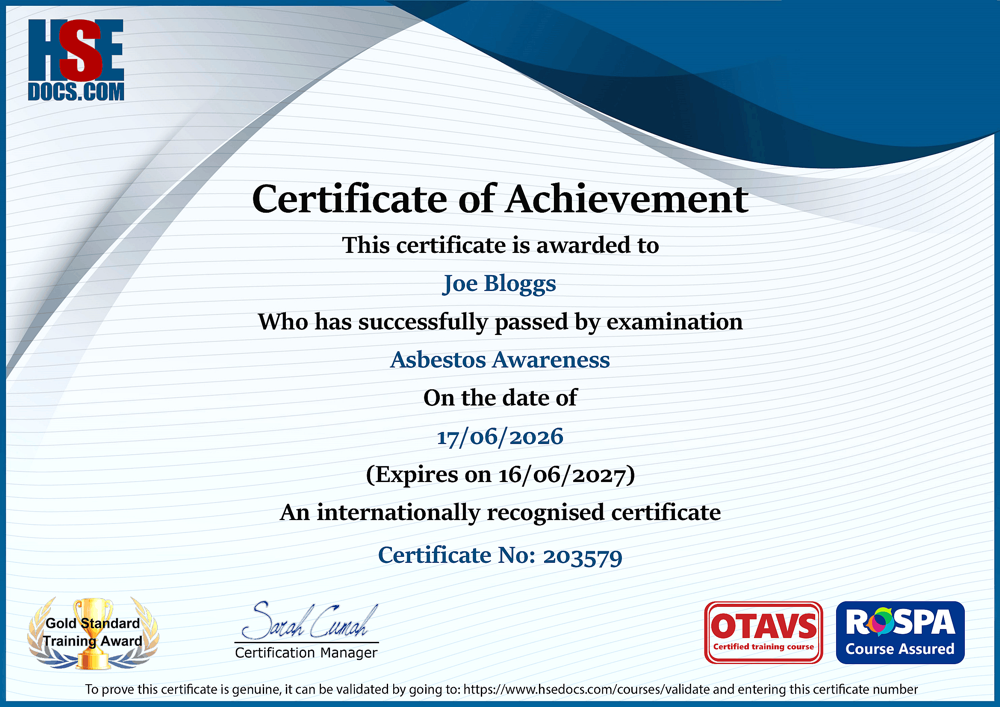
Download your manual handling awareness certificate as soon as you’ve completed the online training.
This course has been assured and assessed for quality, content and delivery by RoSPA and OTAVS
Save more when you buy in bulk
Course format: Three video training modules, with a multiple-choice section at the end of each module.
Entry Requirements: Anyone can complete this Manual Handling Course, whether they have previous experience or not.
Module 1 explains that manual handling means transporting or supporting a load through bodily force, including lifting, lowering, pushing, pulling and carrying. It introduces the Manual Handling Operations Regulations 1992 and the employer’s duty to:
- Avoid hazardous manual handling where reasonably practicable.
- unavoidable handling risks.
- Reduce those risks as far as reasonably practicable.
It uses the TILE assessment method:
- Task: movements, distances, repetition, posture and required effort.
- Individual: capability, training, health, disability and pregnancy.
- Load: weight, size, stability, grip and hazardous contents.
- Environment: space, flooring, lighting, temperature and ventilation.
Possible controls include modifying the task, using mechanical aids, improving the environment, rotating work, adjusting targets and providing appropriate PPE.
Module 2 describes musculoskeletal disorders affecting the back, upper limbs and lower limbs. Risk factors include heavy or unstable loads, repetitive work, prolonged positions, twisting, stooping, overreaching, fatigue and cold muscles. It explains the spine’s natural curves and emphasises keeping the load close and avoiding twisting.
The recommended lifting process is to:
- Assess the load, route and destination first.
- Decide whether the item genuinely needs moving.
- Seek assistance when the load cannot be handled comfortably.
- Position the feet about shoulder-width apart.
- Bend at the hips and knees while keeping the back aligned.
- Secure the load and hold it close to the body.
- Rise using the leg muscles.
- Turn by moving the feet and whole body rather than twisting.
The course stresses that there is no universal legal maximum lifting weight; capability, posture, frequency and conditions must all be considered.
Module 3 covers mechanical aids:
- Sack trucks for lighter loads.
- Pallet or pump trucks for medium loads.
- Powered lift trucks and forklifts for heavier loads.
A sample of some customers we're proud to train
Teams across the UK use HSEDocs for practical workplace training and recognised certificates.