


Maximum Weight for Manual Handling
In the UK, there isn’t a strict legal limit on how much weight a person can safely lift manually. However, the Health and Safety Executive (HSE) offers some helpful guidelines on what’s considered safe. These guidelines suggest that men should lift no more than 25 kilograms and women no more than 16 kilograms when lifting the item close to the body at waist height. It’s important to keep in mind that these limits drop significantly if the item is further away or being lifted above shoulder height.
Simple Guidelines for Safe Lifting
- Best Lifting Position: When lifting items at waist height and close to your body, men should stick to 25 kg and women to 16 kg. This position helps avoid injury and strain.
- Lifting Above Shoulder Height and Down Low: If you need to lift something above shoulder height, the recommended safe weight drops to 10 kg for men and 7 kg for women. The same weight limits apply when lifting from low positions, like at knee height.
- Lifting with Extended Arms: If you’re lifting something while your arms are stretched out, the advised limit is 10 kg for men and 7 kg for women. Holding an item away from your body increases the strain on your muscles, which is why the limit is lower.
- Twisting or High-Risk Lifting: If your lifting requires twisting, stretching, or frequent repetitive motions, it’s wise to reduce the weight limit by at least 50%. These actions significantly increase the risk of injury, so it’s better to be cautious.
Important Things to Remember
- Not Legal Limits: The recommended safe lifting weights of 25 kg and 16 kg are just guidelines for lower-risk situations, not legal maximums that apply in every case. Employers need to adjust these figures based on the specific lifting tasks at hand.
- Assessing Risks: Employers are required to conduct careful assessments of the Task, Individual, Load, and Environment (T.I.L.E.). This helps them create a safer lifting plan tailored to the particular setting.
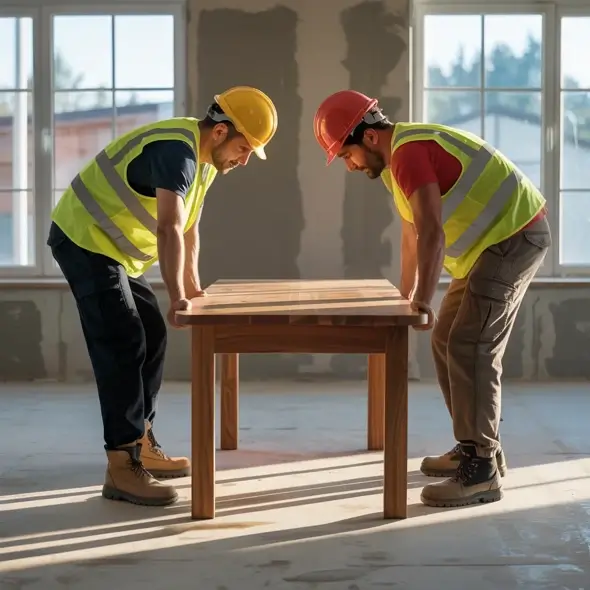
- Lifting with Two People: When two people work together to lift something, the total weight they lift should be no more than two-thirds of their combined lifting abilities. This helps distribute the effort evenly and reduces the risk of injury.
To ensure safety during lifting tasks, both individuals and employers must regularly assess the weight being lifted, provide proper training, and use mechanical aids whenever possible.
Common Types of Manual Handling
Of course, manual handling does not just involve lifting, and some common manual handling tasks may involve:
- Lifting: This involves the vertical movement of a load, which can range from picking up items from the floor to placing them on shelves that are significantly higher. Proper lifting techniques are crucial to prevent injuries, emphasising the use of legs rather than the back and the importance of keeping the load close to the body.
- Lowering: The process of safely placing items from elevated positions to lower levels. It is important to control the load's descent to avoid abrupt drops, which can cause damage or injury. Ensuring a stable footing and proper posture during this action is essential.
- Carrying: Carrying entails transporting a load from one location to another while maintaining a grip on it. This can be challenging, as it requires balance and strength, especially when navigating through tight spaces or uneven surfaces. It is important to assess the load's weight and size beforehand to determine whether assistance or tools like dollies are needed.
- Pushing: This action involves applying force to move a load away from one’s body. Common examples include operating trolleys, carts, or transport cages. Correct posture and body mechanics can significantly reduce strain and increase efficiency while pushing, which may involve using one's body weight to assist in movement.
- Pulling: Pulling involves exerting force to bring a load closer to the body, a technique often used for moving pallets or similar heavy items. Similar to pushing, it is vital to use proper body mechanics to avoid back strain, and one should ensure a stable stance while pulling to maintain control over the load.
- Supporting/Holding: This task involves maintaining the weight of an object or a person, often leading to static strain when held for extended periods. Proper techniques and the use of supportive equipment can help distribute weight and reduce fatigue during these activities.
- Repetitive Tasks: Actions performed frequently and consistently, such as moving stock in a warehouse or performing repetitive manual tasks, such as pipetting, in a laboratory setting. Over time, repetitive tasks can contribute to strain injuries, so it's important to incorporate breaks and varied tasks to reduce the risk.
- Team Operations: This involves the coordinated manual movement of items by two or more individuals working together. Effective communication and teamwork are essential for ensuring safety and efficiency during these operations, allowing team members to navigate and manage heavier loads as a unit.
- Health and Safety Considerations: It is important to prioritise health and safety in all manual handling activities. Proper training in techniques, awareness of physical limitations, and the use of mechanical aids and PPE can minimise the risk of injury.