Online Slips, Trips and Falls Course
Course last updated: June 2026
Course certificate valid for 3 years
UK & EU accredited training
Course duration: 1 hr 15 mins
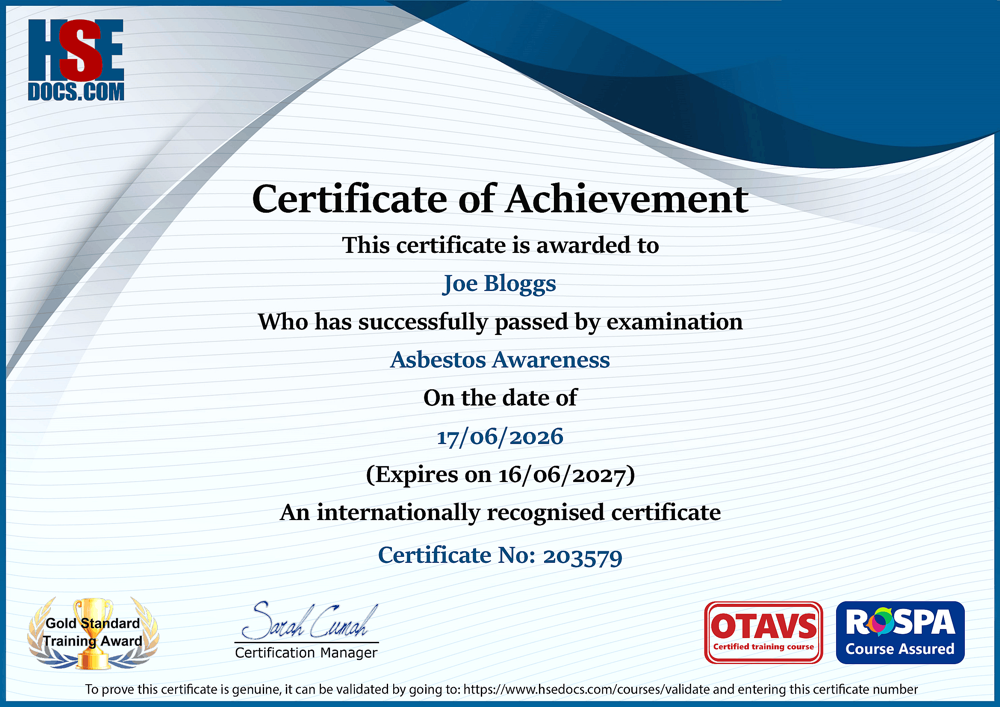
Download your slips, trips and falls awareness certificate as soon as you’ve completed the online training.
This course has been assured and assessed for quality, content and delivery by RoSPA and OTAVS
Save more when you buy in bulk
Course format: Three video training modules, with a multiple-choice section at the
end of each module.
Entry Requirements: Anyone can complete this Slips, Trips and Falls Course, whether they have previous experience or not.
The document is a three-module Slips, Trips and Falls course focused on same-level falls rather than falls from ladders, roofs or other heights.
Module 1 covers legal responsibilities, accident rates and common causes. Employers must assess risks and keep employees, visitors and other affected people safe so far as reasonably practicable. Employees must report hazards they encounter. The principal legislation discussed is:
- Health and Safety at Work etc. Act 1974.
- Management of Health and Safety at Work Regulations 1999.
- Workplace (Health, Safety and Welfare) Regulations 1992.
Common hazards include contaminated or uneven floors, poor lighting, damaged surfaces, trailing cables, open drawers, obstructions and stationary forklift forks. Distraction, rushing, unsuitable routes and carrying items that obstruct vision increase the risk.
Module 2 follows a person from a workplace car park to the building entrance and identifies numerous possible hazards, including:
- Darkness, glare and poorly positioned floodlights.
- Ice, oil, mud, wet leaves and blocked drainage.
- Potholes, gravel and changes in surface level.
- Poorly parked vehicles and moving delivery traffic.
- Missing pedestrian routes or traffic controls.
- Moss, weeds and encroaching vegetation.
- Leaking gutters, unsafe windows, slopes and missing handrails.
The main lesson is that employees should report hazards promptly rather than assuming management already knows about them.
Module 3 explains control measures. These include suitable lighting, routine inspections, prompt spill treatment, salt and grit for icy conditions, barriers and warning signs, effective drainage, safe pedestrian routes, traffic segregation, well-maintained paths, appropriate handrails, anti-slip steps and entrance canopies.
It also addresses behavioural factors. Workers should avoid using phones or performing other distracting tasks while walking, carrying loads that block their view, entering doorways awkwardly or using stairs without a free hand for the rail. Suitable footwear and a willingness to stop unsafe work are equally important. The course’s central message is simple: a risk is something that can cause harm, while a control measure removes or reduces that risk. Preventing falls depends on good maintenance, sensible behaviour and the consistent reporting of even seemingly minor hazards.
A sample of some customers we're proud to train
Teams across the UK use HSEDocs for practical workplace training and recognised certificates.