
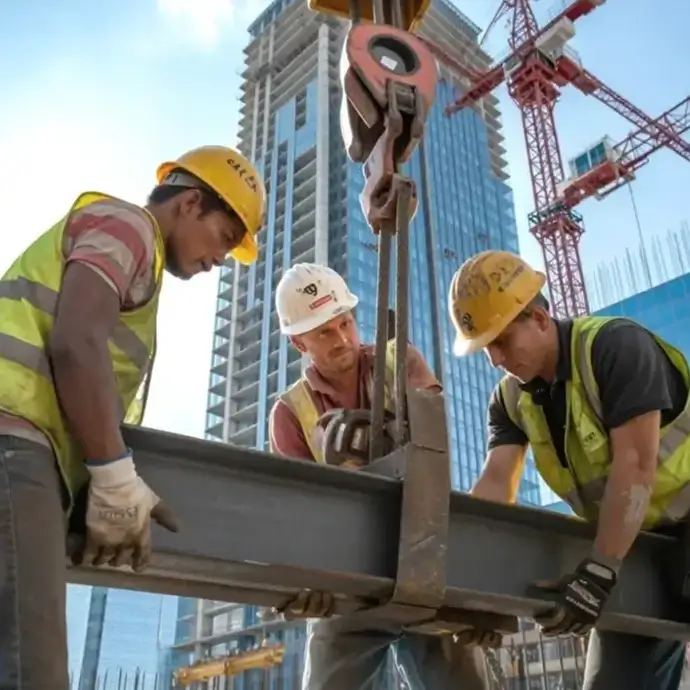


Key Benefits of Construction Health and Safety Training
The construction industry often involves challenging work environments with ongoing safety risks. Construction health and safety training educates workers about risks and equips them with the necessary knowledge to perform their tasks safely and in accordance with best practices.
The primary goal of construction health and safety training is to prevent accidents and Injuries.
Nobody goes to work to get injured; yet, construction sites are inherently fraught with risks, including potential falls from heights, malfunctions of plant and machinery, and exposure to hazardous substances such as chemicals or asbestos.
Safety training helps workers identify potential hazards, adopt safe working practices and select the right personal protective equipment (PPE) for the task.
Construction health and safety training enables workers to identify and mitigate risks, thereby contributing to a safer work environment for everyone. When employees are well-trained, they become more aware of their surroundings and the potential hazards associated with their tasks. This awareness not only reduces the likelihood of accidents but also promotes better decision-making under pressure.
In addition to improving safety, such training positively impacts overall job performance. Workers who feel confident in their knowledge and abilities tend to be more efficient and focused, resulting in fewer disruptions and more consistent project timelines.
Furthermore, employees with proper training are better equipped to respond quickly and effectively, with their decision-making process reflecting what they have been taught.
Construction Health and Safety Training for Manual Handling
Manual handling training within the construction industry is crucial for preventing workplace injuries, ensuring compliance with regulatory standards, and promoting both safety and productivity. This training equips workers with practical techniques for lifting and carrying, thereby reducing the risk of musculoskeletal disorders (MSDs) and other injuries.
The significance of manual handling training is underscored by the physically demanding nature of construction work, which exposes employees to a heightened risk of various injuries. Through comprehensive instruction, employees learn to apply proper lifting methods, such as bending at the knees, utilising leg strength rather than the back, and maintaining correct posture. The adoption of these techniques significantly reduces the incidence of common injuries, including muscle strains, sprains, and chronic back pain, thus supporting long-term workplace health.
Training programmes place particular emphasis on the prevention of MSDs, which account for over 30% of work-related illnesses. They provide practical, accessible guidelines designed to reduce the likelihood of developing these conditions. Furthermore, training addresses misconceptions about manual handling, highlighting that injuries can arise not only from lifting heavy loads but also from improper posture and positioning during routine tasks.
Obtaining a manual handling qualification provides numerous benefits, including compliance with the Manual Handling Operations Regulations 1992, which require employees to follow established safety procedures. In situations where employees have not received adequate training and an injury arises, employers bear full responsibility, potentially incurring significant legal and financial consequences.
Statistics indicate that 27% of all workplace injuries resulting in absences exceeding one week are due to manual handling incidents, with mandatory reporting to the HSE required for such cases. The majority of these injuries are preventable through appropriate training interventions. Injuries often involve damage to the lower back and spine, particularly vulnerable regions due to their structural role and range of mobility. Notably, the recurrence rate for back injuries stands at 70%, with repetitive poor posture constituting a major contributing factor—an issue that practical training can help mitigate.
Investing in comprehensive manual handling training demonstrates a commitment to staff welfare and regulatory compliance. Our cost-effective training solutions are available across all platforms. Ensure a safer workplace environment by enrolling your team in manual handling training today.
Construction Health and Safety Training for Slips, Trips and Falls
Slips, trips, and falls are the most common cause of workplace injuries, with approximately 37% of reported injuries being attributed to them. These incidents are responsible for a significant number of workplace injuries, with statistics indicating that slips, trips, and falls on the same level account for 32% of non-fatal injuries.
In the construction industry, the scope for injury through a slip, trip, or fall is higher than in many other lines of work due to the nature of the work. If a construction worker is carrying a load and slips, it can easily come loose from their grasp, potentially injuring them or others. Risks of injury are also increased when workers carry out tasks at height, near excavations, or on uneven ground.
Trailing cables, tools, and materials in walkways, as well as the unfamiliarity of various parts of a construction site as it evolves and changes during the build, are all hazards that increase the risk of a slip, trip, or fall on a construction site.
Educating employees about the significance of identifying, reporting, and mitigating potential risks associated with slips, trips, and falls is crucial for creating a safe working environment. Incidents, which can result in serious injuries or even long-term disabilities, often stem from overlooked hazards such as wet floors, uneven surfaces, poor lighting, or cluttered walkways. A safer working environment is created by increasing awareness of these risks and emphasising their prevalence.
Teaching workers that both environmental hazards, such as frayed carpet or poor lighting, and personal hazards, such as running downstairs, are equally important to preventing injuries on site.
Construction Health and Safety Training for Work at Height
Work at heights training is such an important tool in construction due to the high risk of falls, which are a leading cause of fatalities and serious injuries. Training provides workers with a deeper understanding of the risks and hazards associated with working at heights, helping them identify hazards and use access equipment safely and properly.
Training also teaches candidates that working at height is actually about the risk of falling to a lower level, regardless of the height at which they are working. Consequently, a person who’s working 300 metres below ground in a mine is still classified as a person working at height if there is any risk of them falling to a lower level.
The consequences of a person falling from a height can be catastrophic, and falls from height remain the leading cause of workplace fatalities and injuries in the UK. In the year 2023/24, they accounted for 36% of all worker deaths.
Due to the severity of workplace deaths and injuries caused by workers falling from height, employers must train their staff.
Construction Health and Safety Training for Asbestos Awareness
Asbestos awareness training is crucial for individuals who may encounter asbestos in their work environments. Training provides comprehensive knowledge on products that could potentially contain asbestos, helps candidates understand the potential health risks associated with asbestos exposure, and instils the importance of not disturbing asbestos-containing materials (ACMs).
It is particularly critical for professionals in the construction, maintenance, and refurbishment sectors, where the likelihood of encountering asbestos materials is significantly higher. Participants in this training learn about the various forms and uses of asbestos, the legal regulations governing its handling, and why licensed professional contractors must carry out disturbance and disposal.
Asbestos awareness equips candidates with the knowledge to understand the risks associated with exposure, and some key aspects of asbestos awareness training include:
- Illustrating the Minuscule Size of Asbestos Fibres: Participants will learn about the microscopic nature of asbestos fibres, which are often invisible to the naked eye. This section emphasises the human body's lack of natural defences against these tiny particles, highlighting how easily they can be inhaled or ingested.
- Understanding Health Risks: The training highlights serious health conditions associated with asbestos exposure, such as mesothelioma, lung cancer, and asbestosis. Participants will review statistics on disease prevalence and mortality rates, underscoring the critical importance of prevention.
- Regulatory Awareness: Attendees will be educated on the strict regulations surrounding asbestos, noting that it is a banned substance in many countries. They will learn to recognise that buildings constructed before the year 2000 are likely to contain asbestos, which necessitates adherence to safety guidelines and regulations when working in such environments.
- Identifying Asbestos-Containing Products: The course features a comprehensive pictorial section that showcases a variety of everyday products and materials commonly containing asbestos. Participants will gain insight into specific items that may be found in the workplace, enabling them to recognise potential hazards and take proactive measures.